Bill Eddy's BIFF Method: A Co-Parenting Guide
Brief, Informative, Friendly, Firm. A licensed therapist walks through Bill Eddy's BIFF method with real co-parenting examples.

The Short Answer
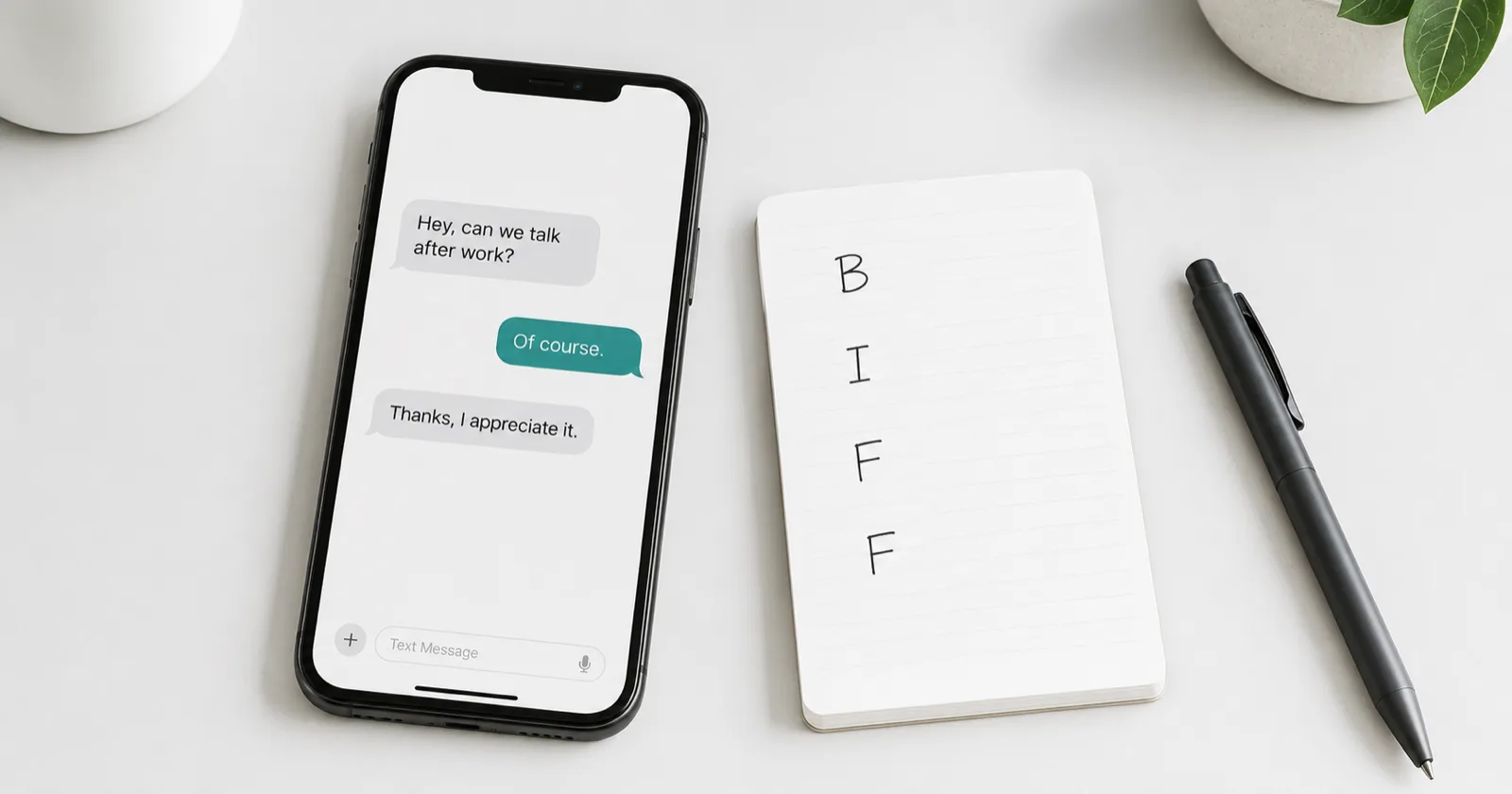
The BIFF method, developed by family law attorney and therapist Bill Eddy of the High Conflict Institute, is the most effective framework for responding to high conflict co-parenting communication. Every response should be Brief (two to four sentences), Informative (facts and logistics only), Friendly (neutral tone, never hostile), and Firm (no openings for further argument). BIFF will not change your ex. It will protect you, conserve your energy, and build a calm paper trail if you ever end up in court.
Key Takeaways
- Bill Eddy is a Licensed Clinical Social Worker, family law attorney, and founder of the High Conflict Institute.
- BIFF stands for Brief, Informative, Friendly, and Firm. Every word matters.
- BIFF is designed specifically for high conflict communication, not for normal exchanges.
- The two-to-four-sentence rule is the most important constraint. The more upset the other person is, the shorter your response should be.
- BIFF will not make your ex less difficult, but it will keep you out of fights you cannot win and build a court-friendly paper trail.
Reviewed and written by Cindy Weathers, LMFT, a Licensed Marriage and Family Therapist and co-founder of Two Paths. Cindy specializes in high conflict divorce, co-parenting after betrayal, and helping separated parents build functional partnerships for the sake of their children.
If your ex is high conflict, you already know what it feels like to receive a text that ruins your morning.
It is not just rude. It is accusatory. It is designed to provoke. And if you respond the way your gut wants to respond, you are going to spend the next three days in a fight that hurts your kids and gets you nowhere.
There is a better way. And it comes from Bill Eddy, the most influential voice in high conflict family law and co-parenting in the country.
Eddy is a licensed clinical social worker, a family law attorney, and the founder of the High Conflict Institute. He has spent his career working with personality disordered ex spouses, contentious custody cases, and the courts that have to manage them. The method he developed for responding to high conflict communication is called BIFF, and it works.
I use it with my clients. I use it in my own life. Once you understand it, you will never write another reactive text to your ex again.
What BIFF Stands For
BIFF is an acronym. Every response you send to a high conflict co-parent should be.
Brief.
Informative.
Friendly.
Firm.
That is it. Four words. The entire framework.
What makes BIFF different from "just stay calm" advice is that each letter is a specific constraint, and the constraint is what protects you.
Let me show you what each one actually means.
B Means Brief
Most BIFF responses are two to four sentences. That is it.
When your ex sends you a long, accusatory text, "You are always late, you never respect my time, you are doing this on purpose, the kids are suffering because of you," your instinct is to match the length. To defend every accusation. To prove they are wrong about each point.
Do not do that.
Long responses do three things, all bad.
- They give the high conflict person more material to attack.
- They make you look defensive, which is what they want.
- They drain you emotionally and pull you back into the fight.
If you are writing more than four sentences, you are writing for yourself, not for the situation. Cut it.
Eddy's rule of thumb. The more upset the other person is, the shorter your response should be.
I Means Informative
The body of a BIFF response is information. Just facts. Just logistics.
Not feelings. Not history. Not explanations of why they are wrong about you. Information.
Not informative, full of emotion: "I cannot believe you are accusing me of being late on purpose. I have a job. I have a life. I am doing my absolute best to make this work and you constantly find ways to criticize me."
Informative: "Pickup tomorrow will be at 5pm as scheduled. If anything changes on my end, I will let you know by noon."
Notice what is missing from the good version. No defense, no counterattack, no emotional content. Just the information they need to plan their day.
High conflict people thrive on emotional content. When you remove it, you remove the fuel for the fight.
F Means Friendly
This is the one people get wrong most often. "Friendly" does not mean warm. It does not mean pretending you like them. It means not hostile.
A friendly BIFF response sounds neutral. Polite. Almost businesslike. The tone you would use with a coworker you do not know well.
Hostile, do not do this: "Whatever. Pickup is at 5. Do not be late this time."
Friendly: "Pickup is at 5. Thanks."
The "Thanks" at the end seems small, but it does something important. It signals to the high conflict person, and to any third party who might eventually read this exchange, like a judge or a custody evaluator, that you are the reasonable adult.
Why this matters. In high conflict co-parenting, your text history can end up in court. The parent who consistently sounds calm and reasonable wins the court's confidence. The parent who responds with hostility, even justified hostility, loses it.
You are writing for two audiences. Your ex, and the future judge who may read this.
F Means Firm
Firm means this conversation is over.
A firm BIFF response does not invite further discussion. It does not ask questions. It does not leave openings for the other person to keep arguing.
Not firm, invites more conflict: "Pickup is at 5. Let me know if that does not work for you."
Firm: "Pickup is at 5. See you then."
If something genuinely needs to be negotiated, you can negotiate it. But most of the time, your high conflict ex is not trying to solve a problem. They are trying to engage you in conflict. The firm close shuts the door on that engagement.
A Full BIFF Example
Here is a real world high conflict text and a BIFF response. I have changed details from a client case but the structure is real.
Incoming text from ex: "I cannot believe you took Sophia to get her hair cut without asking me. You know I wanted to take her. You always do things behind my back. You are trying to push me out of her life and I am not going to let you. We need to talk about this NOW."
Bad response, what most people would write: "I did not take her behind your back. She had a birthday party Saturday and needed a trim. If you wanted to take her you should have said something. You are the one who tries to make everything into a fight. I am not pushing you out of anything."
That response has 60 plus words, four pieces of emotional content, and three counter accusations. It is going to extend this fight for three more days.
BIFF response: "Sophia got a trim before her birthday party Saturday. Happy to coordinate haircuts going forward. Feel free to schedule the next one when it is during your time. Thanks."
Three sentences. Information only. Friendly close. Firm. It offers a path forward without re engaging the accusations.
That is BIFF.
When BIFF Does Not Apply
BIFF is for high conflict communication. It is not for every conversation.
If your ex is being reasonable, you can be reasonable back. Full sentences, warmth, normal conversation. That is fine. BIFF is overkill for normal exchanges, and overusing it can make you seem cold when you do not need to be.
The signal that BIFF is needed. Your ex is being accusatory, hostile, provocative, or trying to drag you into an emotional argument. Match BIFF to those moments. Use normal communication for everything else.
What BIFF Does Not Fix
BIFF will not change your ex. It will not make them suddenly reasonable. It will not end the conflict.
What BIFF does is protect you. It keeps you out of fights you cannot win. It builds a paper trail of you being the calm one. It conserves your emotional energy for the things that actually matter. Your kids, your life, your own healing.
If your ex has a personality disorder, BIFF is one of the only communication strategies that consistently does not make things worse. Eddy's research at the High Conflict Institute has shown that high conflict people do not respond well to logic, validation, or apology. But they have a much harder time fighting with someone who is brief, informative, friendly, and firm.
You are not trying to win. You are trying to keep your peace.
If your situation is severe enough that BIFF alone is not protecting you, our guide on co-parenting with a narcissist goes deeper into the specific dynamics personality disordered exes create, and what works when standard advice fails.
The Two Person Rule for BIFF
One more practical tip from Eddy's work that I share with every client. Before you send any response to a high conflict ex, run it past one trusted person.
Not to vent. Not to be told you are right. To get one outside set of eyes on whether the response is actually BIFF, or whether it is leaked emotion you do not realize is there.
Most people cannot see the hostility in their own writing. A friend, a therapist, a co-parent coach can. Use them.
Our message decoder can also serve this purpose. Paste in the draft response you are about to send, and you will get a read on whether it actually lands as BIFF or whether there is emotional leakage you missed.
The Bottom Line
Bill Eddy gave the world a tool that takes about two minutes to learn and the rest of your life to master.
Brief. Informative. Friendly. Firm.
Print it. Put it on a sticky note on your monitor. Re read it before every response you send to your ex for the next six months.
It will not make your co-parent less difficult. But it will make you less reactive. And that is the only piece of this dynamic you can actually control.
For specific scripts you can copy when your ex starts an argument over schedule changes, holidays, or expenses, our BIFF response examples guide walks through 12 real situations and the BIFF answer for each.
Frequently Asked Questions
Who is Bill Eddy?
Bill Eddy is a Licensed Clinical Social Worker, a family law attorney, and the founder of the High Conflict Institute, based in San Diego. He has authored more than 20 books on high conflict personalities, divorce, and the legal system. He developed the BIFF response method as a practical tool for anyone communicating with high conflict people, including divorced co-parents, but also workplace situations, family members, and other relationships.
What does BIFF stand for?
BIFF stands for Brief, Informative, Friendly, and Firm. Every response you send to a high conflict co-parent should hit all four. Brief means two to four sentences. Informative means facts and logistics only, no feelings or history. Friendly means a neutral, businesslike tone. Firm means closing the door on further argument.
Does the BIFF method work with a narcissist?
BIFF is one of the only communication strategies that consistently does not make things worse with a narcissist or other personality disordered ex. It will not change them. It will not make them reasonable. But it will deny them the emotional reaction they are trying to provoke, which over time tends to reduce the volume of incoming attacks. For deeper guidance on this dynamic, see our co-parenting with a narcissist guide.
How long should a BIFF response be?
Two to four sentences. That is the rule. If your response is longer than four sentences, you are almost certainly writing for yourself instead of the situation. Cut everything that is not necessary information. The more upset the other person is, the shorter your response should be.
Is BIFF rude or cold?
BIFF can feel cold compared to a normal conversation, but it should not read as hostile. The "Friendly" letter is doing the work here. A polite "Thanks" at the end, or a warm but neutral phrase like "Hope your week is going well" can soften a BIFF response without inviting argument. The goal is businesslike, not robotic.
Can I use BIFF for email and not just texts?
Yes. BIFF works across any written channel. Text, email, parenting app messages, even physical letters. The principles are the same. Brief, Informative, Friendly, Firm. Some co-parents find email easier because the slight delay before sending helps them resist reactive responses.
What if BIFF does not work and the conflict keeps escalating?
If you have been using BIFF consistently for a few months and your ex continues to escalate, that is information. It usually means one of two things. Either you are leaking emotion into your responses without realizing it, in which case running drafts past a therapist or trusted friend can help. Or your ex is in a particularly extreme phase where no communication strategy is going to interrupt the pattern. In those cases, parallel parenting with rigid structure and minimal direct contact is the next step.
Where can I learn more about Bill Eddy's BIFF method?
The High Conflict Institute publishes books, online courses, and free articles on BIFF and related methods. Eddy has written specifically about BIFF in his book BIFF: Quick Responses to High Conflict People. For co-parenting examples specifically, our BIFF response examples guide translates the method into 12 real co-parenting situations.
Need guidance for your situation?
Two Paths gives you structured support from licensed professionals — in the moment you need it most.
Download Two Paths